HEALTH
Health education is a profession of educating people about health.
Areas within this profession encompass environmental health, physical
health, social health, emotional health, intellectual health, and
spiritual health.It can be defined as the principle by which individuals and groups of
people learn to behave in a manner conducive to the promotion,
maintenance, or restoration of health. However, as there are multiple definitions of health,
there are also multiple definitions of health education. The Joint
Committee on Health Education and Promotion Terminology of 2001 defined
Health Education as "any combination of planned learning experiences
based on sound theories that provide individuals, groups, and
communities the opportunity to acquire information and the skills needed
to make quality health decisions."
The World Health Organization defined Health Education as "compris[ing]
[of] consciously constructed opportunities for learning involving some
form of communication designed to improve health literacy, including
improving knowledge, and developing life skills which are conducive to
individual and community health."
-Determines what health problems might exist in any given groups
-Includes determination of community resources available to address the problem
-Community Empowerment encourages the population to take ownership of their health problems
-Includes careful data collection and analysis
-Involves the development of goals and objectives which are specific and measurable
-Interventions are developed that will meet the goals and objectives
-According to Rule of Sufficiency, strategies are implemented which are sufficiently robust, effective enough, and have a reasonable chance of meeting stated objectives
-Utilize a wide range of educational methods and techniques
-Health Educators make use of research to improve their practices.
-Involves facilitating cooperation among personnel, both within and between programs
-Address diverse audience in diverse settings
-Formulates and support rules, policies and legislation
-Advocate for the profession of health education
Why should I care about Health education?
The Role of Health Education Specialists
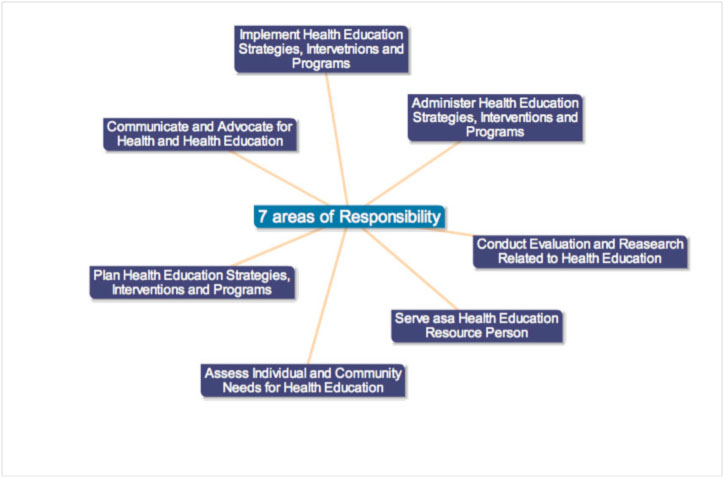
From the late nineteenth to the mid-twentieth century, the aim of public health was controlling the harm from infectious diseases, which were largely under control by the 1950s. By the mid 1970s it was clear that reducing illness, death, and rising health care costs could best be achieved through a focus on health promotion and disease prevention. At the heart of the new approach was the role of a health educator A health educator is “a professionally prepared individual who serves in a variety of roles and is specifically trained to use appropriate educational strategies and methods to facilitate the development of policies, procedures, interventions, and systems conducive to the health of individuals, groups, and communities” (Joint Committee on Terminology, 2001, p. 100). In January 1978 the Role Delineation Project was put into place, in order to define the basic roles and responsibilities for the health educator. The result was a Framework for the Development of Competency-Based Curricula for Entry Level Health Educators (NCHEC, 1985). A second result was a revised version of A Competency-Based Framework for the Professional Development of Certified Health Education Specialists (NCHEC,1996). These documents outlined the seven areas of responsibilities which are shown below.
Responsibility I: Assessing Individual and Community Needs for Health Education
-Provides the foundation for program planning-Determines what health problems might exist in any given groups
-Includes determination of community resources available to address the problem
-Community Empowerment encourages the population to take ownership of their health problems
-Includes careful data collection and analysis
Responsibility II: Plan Health Education Strategies, Interventions, and Programs
-Actions are based on the needs assessment done for the community (see Responsibility I)-Involves the development of goals and objectives which are specific and measurable
-Interventions are developed that will meet the goals and objectives
-According to Rule of Sufficiency, strategies are implemented which are sufficiently robust, effective enough, and have a reasonable chance of meeting stated objectives
Responsibility III: Implement Health Education Strategies, Interventions, and Programs
-Implementation is based on a thorough understanding of the priority population-Utilize a wide range of educational methods and techniques
Responsibility IV: Conduct Evaluation and Research Related to Health Education
-Depending on the setting, utilize tests, surveys, observations, tracking epidemiologicaldata, or other methods of data collection-Health Educators make use of research to improve their practices.
Responsibility V: Administer Health Education Strategies, Interventions, and Programs
-Administration is generally a function of the more experienced practitioner-Involves facilitating cooperation among personnel, both within and between programs
Responsibility VI: Serve as a Health Education Resource Person
-Involves skills to access needed resources, and establish effective consultative relationships.Responsibility VII: Communicate and Advocate for Health and Health Education
-Translates scientific language into understandable information-Address diverse audience in diverse settings
-Formulates and support rules, policies and legislation
-Advocate for the profession of health education
Why should I care about Health education?
Health education builds students' knowledge,
skills, and positive attitudes about health. Health education teaches
about physical, mental, emotional and social health. It motivates
students to improve and maintain their health, prevent disease, and
reduce risky behaviors.
Health education curricula and instruction
help students learn skills they will use to make healthy choices
throughout their lifetime. Effective curricula result in positive
changes in behavior that lower student risks around:
alcohol, tobacco, and other drugs,
injury prevention, mental and emotional health, nutrition, physical
activity, prevention of diseases and sexuality and family life.
Health education promotes learning in other
subjects! One study showed that reading and math scores of third and
fourth grade students who received comprehensive health education were
significantly higher than those who did not. In general, healthy
students learn better. Numerous studies have shown that healthier
students tend to do better in school. They have higher attendance, have
better grades, and perform better on tests.

